
Searching Montgomery County Criminal Dockets
For a remote docket search, begin at the Kansas District Court Public Access Portal. Pick District first. Then search by case number or party name and narrow the results to Montgomery. A known case number works best. Party searches may need the last-name, first-name order the current form expects, plus filters such as case type, birth date, or filing date to separate people with similar names.
- Open Kansas CaseSearch and choose District.
- Select Case Number or Party Name.
- Set Montgomery County before reading results.
- Compare the full case ID, court location, case type, and parties.
- Open the event history and check the latest setting against local court information.
The local 14th Judicial District calendar gives you a second angle on a criminal docket. It lists event shells and links to posted docket PDFs. Handy for dates, yes. Still, it is no substitute for the chronological events index or the filed documents in the case.
Why Montgomery Criminal Cases Start in Independence
Montgomery County sits in Kansas's Fourteenth Judicial District along with Chautauqua County. Under K.S.A. 20-3107, the district keeps clerk offices in both Independence and Coffeyville. Cases may be assigned or transferred between them. Local rules send all criminal actions to filing in Independence. That is why an Independence code can show up. A later hearing may still happen somewhere else by court order. Think of the district court as one court with two Montgomery offices. There is no separate county court running beside it. The Montgomery County Clerk at the county courthouse keeps county-government records, not criminal dockets. For any criminal docket question, go to the Montgomery County District Court Clerk's Office.
Location code: Local samples use MGI for Independence and MGC for Coffeyville. A prefix identifies the court location, not guilt or the final result.
Inside a Montgomery County Criminal Docket
A local criminal docket PDF is a setting list built around a single court date. The Independence sample published by the court includes the case number and public party name. It also gives the setting label, judge, and related scheduling details. The statewide Kansas events index adds a longer chronological trail. That trail covers filings, hearings, orders, and disposition. Either view helps. Neither one is every document in the file.
| Case ID | A location, year, criminal type code, and sequence, such as MGI 2025 CR 258 |
|---|---|
| Party or caption | The public case name or parties shown in the docket |
| Setting | Arraignment, review, plea, trial, sentencing, show cause, or another event |
| Judge | The judicial officer assigned to that setting |
| Attorney | Counsel information when the report exposes it |
| Notes | Remote appearance, bond, time, or other docket-specific instructions |
Read each line with care. A docket entry saying a motion was filed is not the motion itself. In the same way, a calendar entry naming sentencing does not tell you the sentence. Open the public filing when available. Or request the record from the clerk.
Read Montgomery Criminal Docket PDFs
The local calendar publishes public docket PDFs for scheduled matters. Their columns give you a quick day-of-court view. The Kansas register of actions, meanwhile, offers the longer case trail. Treat posted PDFs as drafts. Local civil and traffic samples warn that late changes may not appear. So bring that same caution to any criminal setting check. The official Independence criminal event example shows the structure. What you see there is an event shell, not personal case identities.
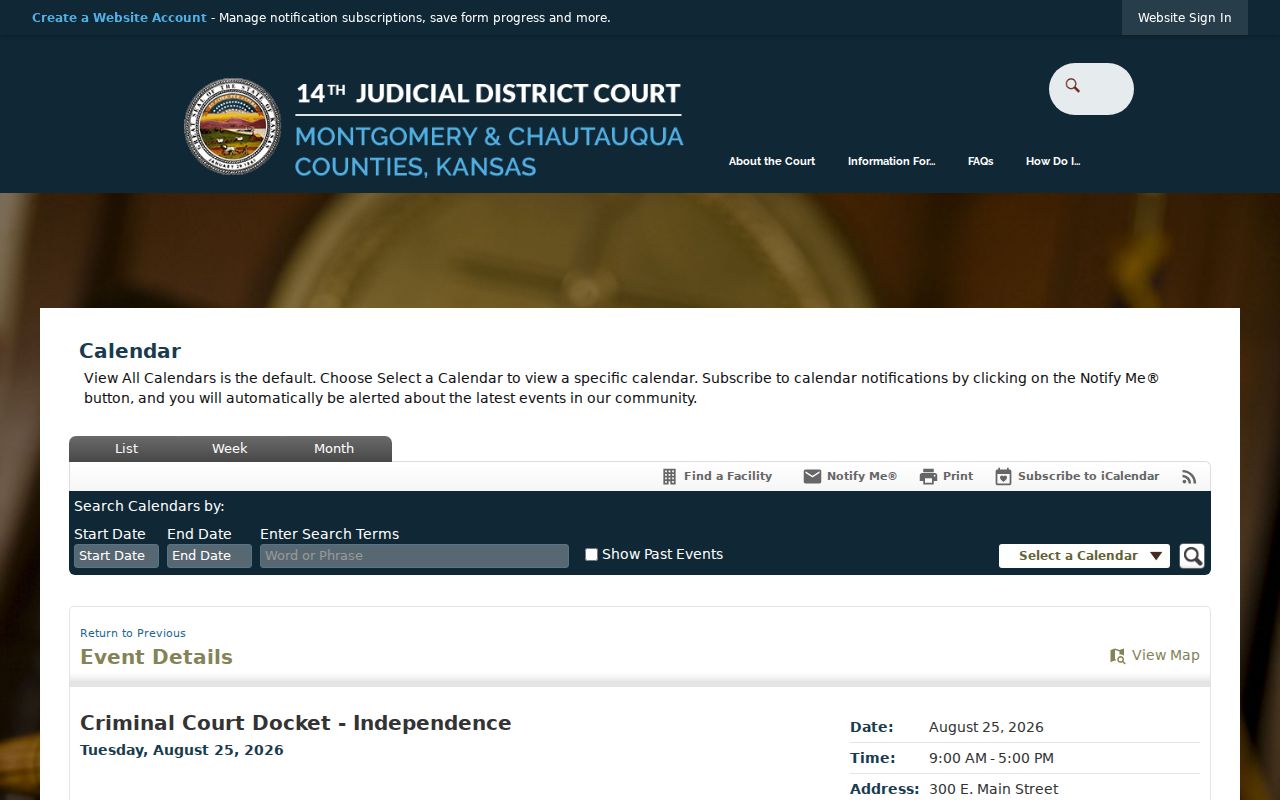
Older local samples sometimes mark a setting "via Zoom." That notation covers one event only. Do not assume a later Montgomery County criminal hearing is remote without a current notice or confirmation from the court.
How a Criminal Case Moves
A Montgomery County criminal docket often follows a broad sequence: Filing → Arraignment → Pretrial → Plea or Trial → Disposition → Sentencing. Real cases can add motions, competency proceedings, bond reviews, continuances, diversion-related reviews, or show-cause settings. Some steps repeat, and a case can resolve before trial.
A criminal docket has its own vocabulary. Arraignment is where the charge and plea are addressed, and a pretrial setting handles issues before trial. A review checks progress or compliance. Disposition is the recorded resolution, sentencing sets the penalty after a conviction or plea, and a "show cause" order directs a person to explain why the court should not take a stated action.
- Setting
- A scheduled court event, not a result.
- Continuance
- An order moving a hearing to another date.
- Disposition
- The formal way a charge or case was resolved.
- Diversion review
- A setting about diversion status or compliance, not proof of final completion.
- Sentencing
- The hearing at which the court imposes sentence after a conviction or plea.
Montgomery Criminal Calendar Patterns
Independence criminal entries recur on Tuesdays. Coffeyville criminal entries run on Thursdays, according to the local calendar. Those are observed patterns, not promises. Holidays, judge assignments, special settings, and court orders can all shift the schedule. The calendar also splits criminal matters from civil, domestic, traffic, probate, limited-action, and small-claims feeds.
Follow one category with the 14th District iCalendar feeds. Subscribing makes updates easier to notice. A personal calendar copy may lag or keep a stale event. Check any critical date against the live event. Also check the case docket and the filed hearing notice.
| Calendar view | What it adds | Main limit |
|---|---|---|
| Month or list | Date, title, category, and event links | May omit special judge settings |
| Docket PDF | Case-level setting rows | Late changes may not appear |
| iCalendar feed | Subscription by docket category | A saved copy is not the court record |
Note: The local clerk FAQ says special settings may not appear on the general calendar. Confirm those with the filed notice or the court.
Courts That Hold Criminal Dockets
Felony and misdemeanor state cases assigned to Montgomery County belong to the Kansas District Court, Montgomery County, Fourteenth Judicial District. Its clerk maintains the events index and the underlying file. Both sit at the Independence and Coffeyville offices. The Sedan office serves Chautauqua County and is not a Montgomery records counter.
Municipal courts play a different role. Independence, Coffeyville, Cherryvale, Caney, and other city courts handle ordinance and city-traffic cases. A city citation may never appear as a Montgomery district criminal case. Federal charges go to the United States District Court for the District of Kansas. Its PACER/CM/ECF record applies, not Kansas CaseSearch.
| Matter | Docket keeper | Starting channel |
|---|---|---|
| Kansas felony or misdemeanor | Montgomery District Court Clerk | Kansas CaseSearch |
| City ordinance charge | Municipal court clerk | Official city court |
| Federal criminal charge | Federal Clerk of Court | PACER or District of Kansas |
If a name search fails, pause before switching systems. Gather the law-enforcement agency, the citation, the case number, and the charging court first.
Montgomery Criminal Docket Access Channels
Going online covers only part of a Montgomery County criminal docket search. Kansas CaseSearch lists public case information. Where eCourt carries an unrestricted image, it shows public filings too. The local calendar handles hearing events and docket PDFs. For open files that never reach the web, both Montgomery clerk offices offer public terminals.
Independence District Clerk
300 E Main Street, Suite 201
Independence, KS 67301
620-330-1070
Monday through Friday, 8 a.m. to noon and 1 to 4 p.m.
Coffeyville District Clerk
102 W 7th Street, Suite A
Coffeyville, KS 67337
620-251-1060
Monday through Friday, 8 a.m. to noon and 1 to 4 p.m.
A phone call works for routing and hearing confirmation, nothing more. The local FAQ is blunt: record-search requests are not taken by phone. Send a request instead. Use the official web form, mail to the Independence office, or fax to 620-331-6120. Legible handwritten delivery also works. No dedicated records email or drop box is listed in state or local sources.
Give the case number, court location, date range, and the exact document you want. Clerk staff can locate and copy a public record. They cannot interpret docket language or hand out legal advice.
If a Criminal Setting Is Missing
Start over with the live calendar and Kansas CaseSearch. A setting may have moved. It may have landed under a different category or on a special judge calendar. Compare the filed notice next, then contact the attorney of record if one is involved. The district clerk office comes last, called with the full case number in hand.
Read a missing row correctly. It is not a dismissal. A reset is not a verdict. Some event titles are just a day-long docket shell, not an individual appointment time. When a setting is imminent, trust nothing saved. Skip the cached PDF, the subscription copy, and the search-engine result.
Urgent date check: Missing a criminal setting can have serious consequences. Confirm the date with the court or attorney at once, and seek licensed legal advice about any missed appearance.
Sealed Dockets and Public Access
Kansas Supreme Court Rule 22 restricts electronic access to certain case types and records. Juvenile matters, child-in-need-of-care proceedings, expunged matters, and sealed cases can drop out of any public Montgomery County criminal docket search. Even where the case index stays public, individual documents may be restricted. Rule 23 governs sealing. Rule 24 makes filers redact protected personal information. Expungement in covered circumstances is addressed by K.S.A. 22-2410 and K.S.A. 21-6614.
Restrictions have teeth. An ordinary public search cannot slip around them, and a courthouse terminal will not open sealed material either. Access requests must go through the court's authorized process.
The Kansas Open Records Act sets procedures for public requests, though its exemptions and the court rules still control. K.S.A. 45-218 covers inspection and response, K.S.A. 45-220 sets request procedures, and K.S.A. 45-221 lists exemptions. Ask for a named public record, not a legal conclusion about the case.
Verify Montgomery Criminal Docket Results
A solid match rests on the full case ID, party role, court location, charge information, filing date, assigned judge, and latest event. Read the whole sequence first. Entries labeled "arraignment," "review," "diversion status," or "sentencing" mark stages or settings. None is a verdict. Without the disposition entry and the relevant order, treat none as one.
Keep the docket separate from a Kansas Bureau of Investigation criminal-history record. The court docket tracks one judicial case. A criminal-history system serves a different statutory function and may draw on different sources. Need a filed judgment or other proof? Get the court document or a certified copy from the clerk.
Montgomery County criminal docket records can shift after a calendar is posted. Use the public tools to find and understand the case, then confirm anything time-sensitive or consequential with the court that keeps the original record. Note: The clerk may explain where a public record sits, but only the court record itself establishes what was filed and ordered.