
Searching the Caney Court Docket
City-ordinance citations belong in the Caney municipal portal. With the ticket in hand, enter the exact citation number and the required birth date. Kansas cases need a different tool. Switch to CaseSearch, pick District and Montgomery County, and run the full case or citation number.
- Confirm that the notice names Caney Municipal Court
- Open the official Caney Municipal Online Services court search
- Choose the least sensitive suitable mode and enter exact data
- If the matter is state court, use Kansas CaseSearch with Montgomery County
- Confirm a near-term setting with the Caney court clerk
Caney Court Portal Modes
Caney sits among the five Montgomery cities on this docket network. Its municipal lookup interface is the widest of the group. Separate search cards cover the options. You can search by citation number, driver's license, Social Security number, vehicle information, personal name, and business name. Plenty of choices, though, is not the same as good judgment. Ordinary public research rarely needs the more sensitive fields.
| Mode | Companion field | Use |
|---|---|---|
| Citation | Date of birth | Preferred with the ticket |
| Name | Date of birth | Use only as the official Caney form permits |
| Business | Business name | Business citation search |
| Vehicle | Plate and state | Mode shown by vendor |
The license and Social Security fields are simply there for people who must use them. Nobody should treat that as a reason to gather private identifiers. Pick the least sensitive reliable mode and stick with it.
Caney Municipal Court Basics
Caney describes its municipal court as a fair and impartial forum. It interprets applicable state laws and city ordinances. Court Clerk Amanda Childers answers at 620-879-2141 and achilders@cityofcaney.org. City Hall sits at 100 West 4th Avenue, Caney, KS 67333.
The city's official vendor exposes six search modes. The list covers citation, license, Social Security number, vehicle, personal name, and business name. Empty search controls are all the interface shows. That plain set of fields says nothing about collecting or casually using sensitive identifiers.
The official Caney Municipal Court page lays out the court's own description and contact details.
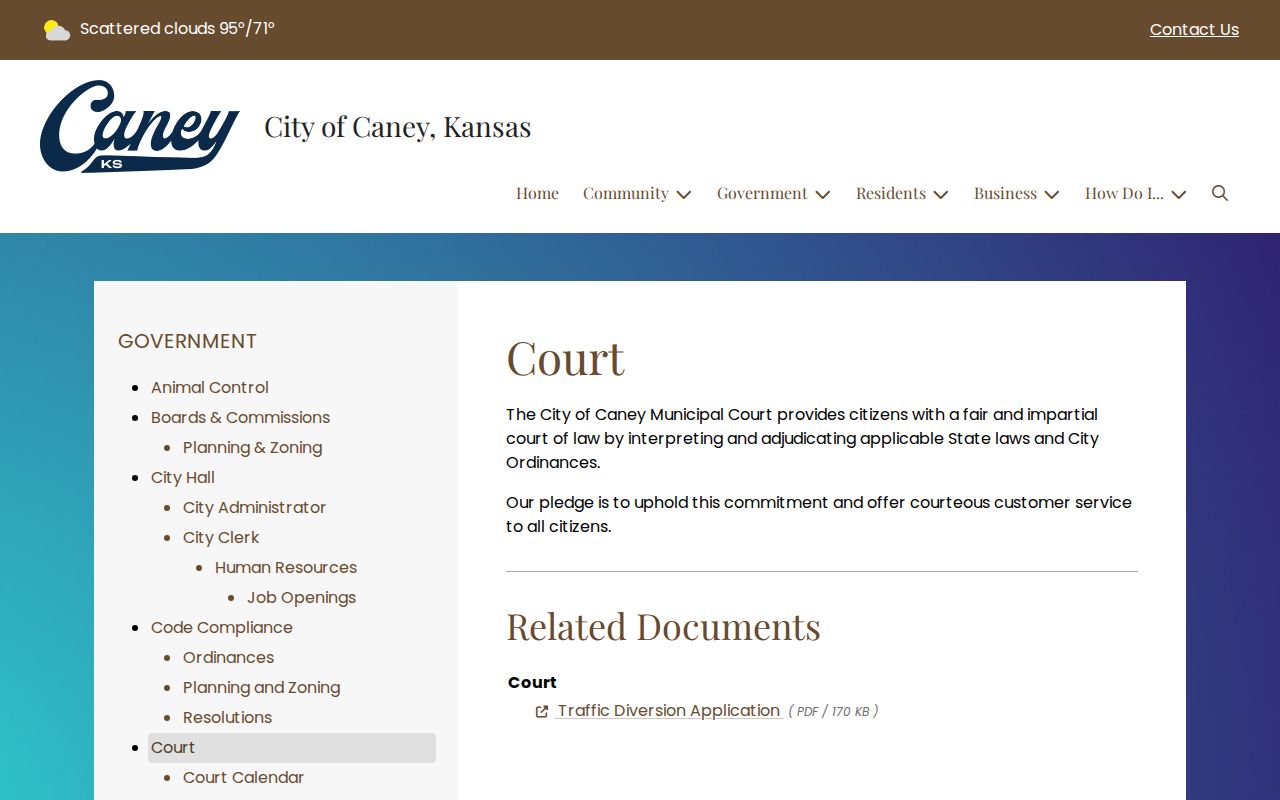
The capture identifies the municipal route without extending it to Kansas District Court matters.
Caney Municipal Docket Search
The Caney Municipal Online Services search greets you with empty fields, a Search button, and optional sign-in or registration. A citation-number search is the cleanest route when the ticket is on hand. It keys on a court-issued identifier instead of a broad personal query.
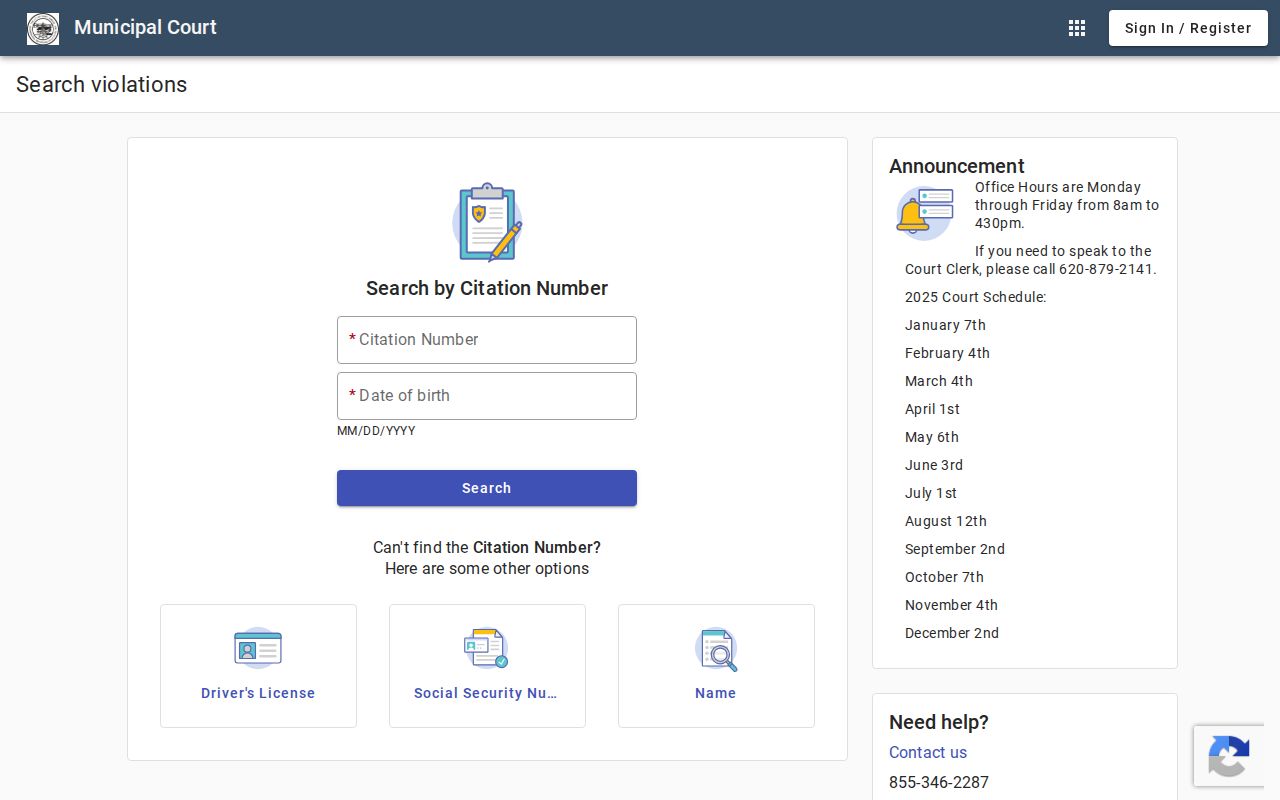
The page shows field labels and nothing more. Pagination, export behavior, document downloads, and result detail depend on an actual search, which requires a real case.
Privacy point: Never publish birth dates, license numbers, Social Security numbers, or plate values taken from a Caney search.
Court Dates and Settings in Caney
Caney holds municipal court on the first Tuesday of each month, starting at 10 a.m. That rhythm helps orient a docket search. Still, the citation, a reset notice, a holiday change, or current clerk instruction governs the date for any one case.
| Date | The citation date or current first-Tuesday notice |
|---|---|
| Time | The published 10 a.m. start or an individual time |
| Courtroom | Caney City Hall or another location stated by the court |
| Judge | The judicial officer shown on the current record |
| Setting Type | The event named on the ticket, notice, or docket |
Caney First-Tuesday Court Docket
The Caney Court Calendar posts court at 10 a.m. on the first Tuesday of each month.
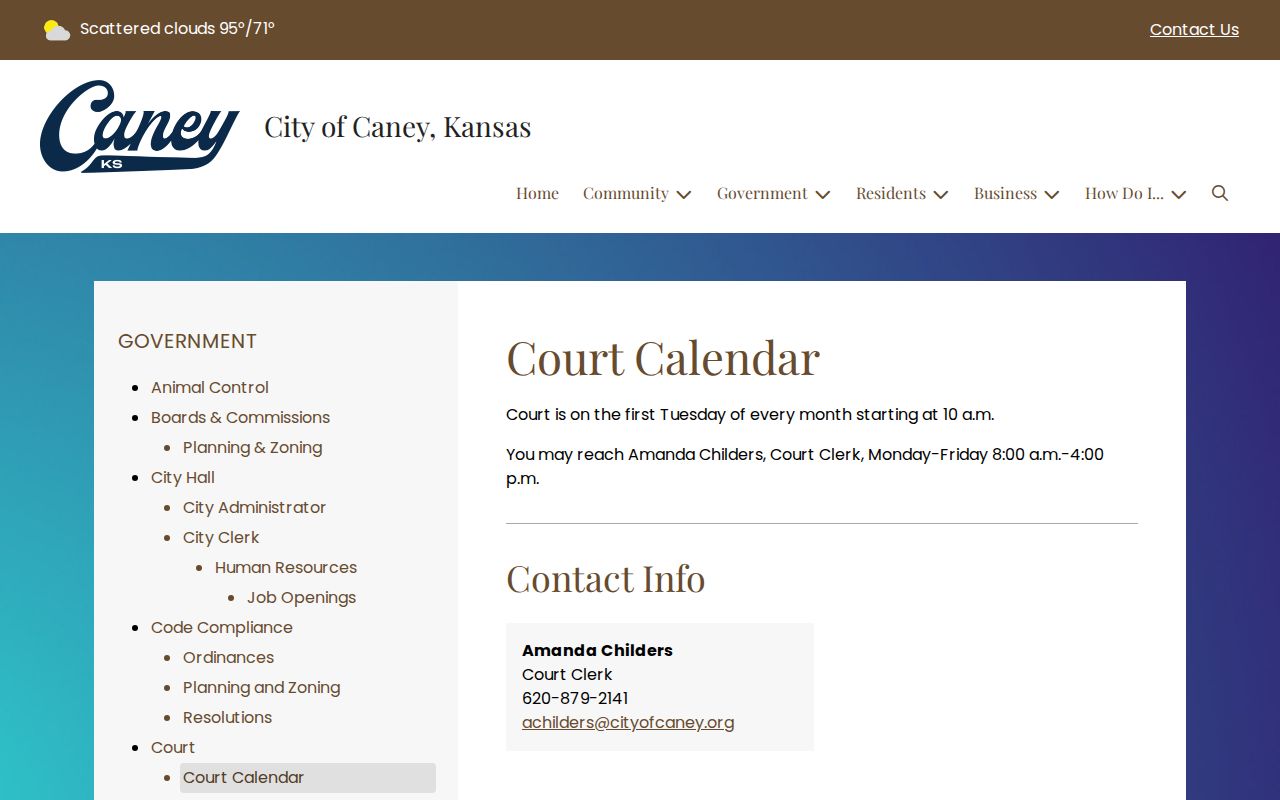
Treat that schedule as a recurring guide. The citation and the latest notice still control a particular hearing. So does clerk confirmation, after any reset, holiday, or special setting.
A reset simply means the hearing moved. It is not a dismissal and not a final result. If the Caney vendor and your notice disagree, call Court Clerk Amanda Childers at 620-879-2141. Do that before you appear.
Traffic Tickets in Caney
For a Caney municipal ticket, use the exact citation-number mode when you can. The form pairs it with date of birth. A Kansas state traffic citation is a different animal. That one belongs in CaseSearch. The Caney vendor is no substitute for the District Court index.
The court page links a Traffic Diversion Application but posts no numeric fine table. Rely on the citation itself. Ask the clerk about current payment, contest, or diversion steps.
Caney Courtroom Docket Rules
Caney's procedures page calls the docket the schedule of court and lists plain courtroom rules. Phones and mobile devices must be off. Photography and audio recording are prohibited. Food and drink stay outside the courtroom. Keep these municipal rules separate from district public-terminal procedures.
The Caney court procedures page publishes that local protocol.
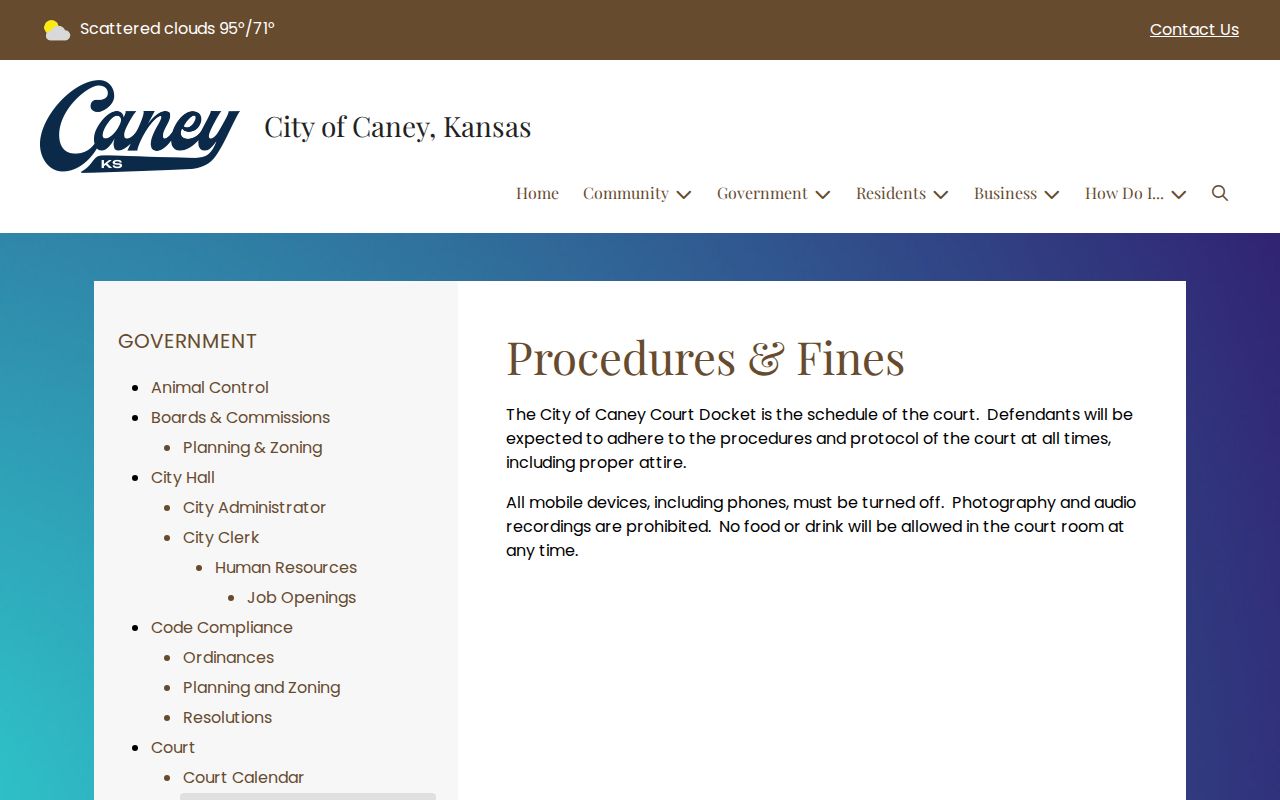
No numeric fine table appears on the city's court page. Ask the clerk for current amounts rather than guessing from the page title.
Where Caney Cases Go
Caney ordinance cases stay in municipal court. Kansas criminal, traffic, civil, domestic, probate, and small-claims matters go to District Court in Montgomery County. Those district counters sit in Independence and Coffeyville, not Caney.
Docket flow: Caney Municipal Court › Montgomery County Courts › District Court
For state CaseSearch, district calendars, terminals, and written requests, use the Montgomery County court docket overview. The Caney vendor should stay limited to city matters.
Caney Public Record Fallback
A portal can find a ticket or balance yet never show the underlying public document. Caney fills that gap with a written public-information process. The city accepts requests hand delivered, mailed, faxed, or emailed. Use that route for an existing docket entry, judgment, or other named city record the vendor does not display.
The Caney public-information request page spells out the written fallback.
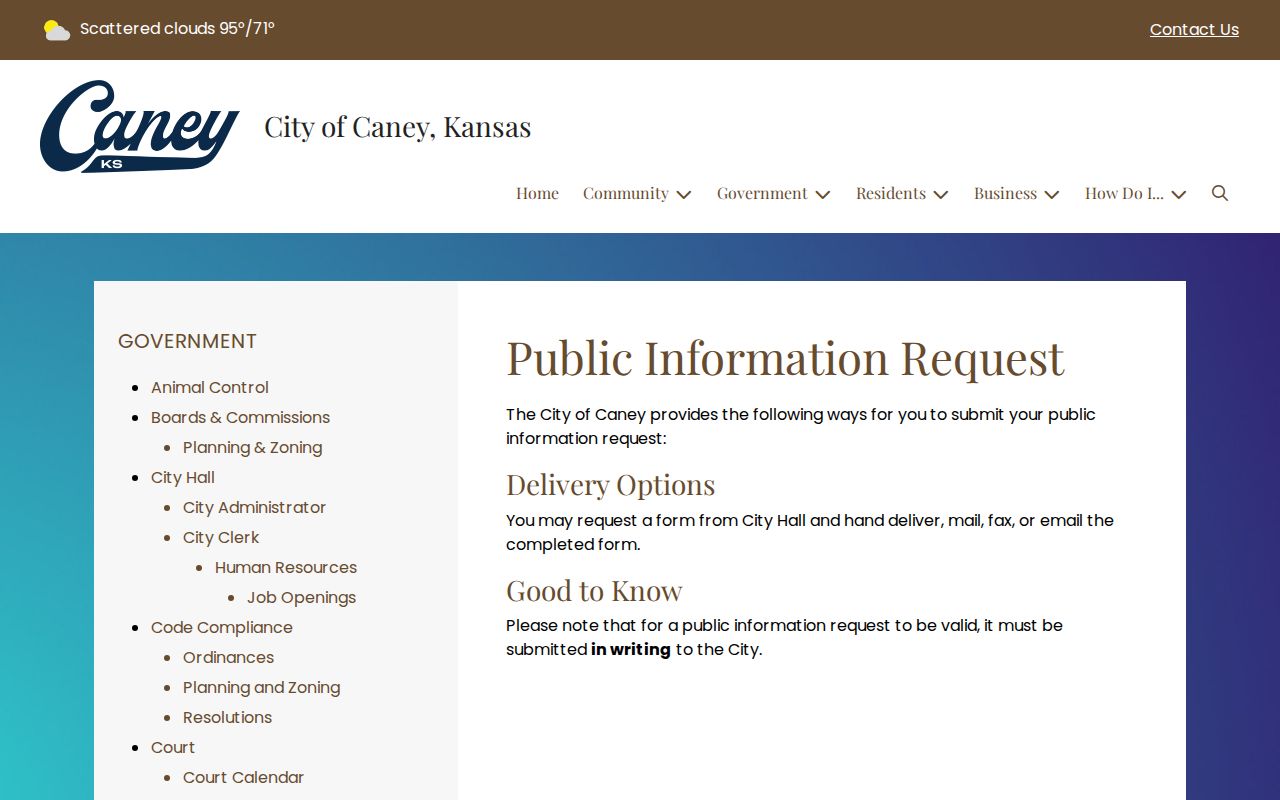
For a document need, the request channel beats experimenting with sensitive search modes. Name the citation, the record, and any useful date.
Caney Court Record Access Rules
When a public Caney city document is not visible online, the written public-information route applies. Requests may be hand delivered, mailed, faxed, or emailed. District records run through the Montgomery clerk under Kansas access rules.
Key Rules:
K.S.A. 45-218 requires prompt action on public-record requests.
Kansas Supreme Court Rule 22 limits remote access by case type, document type, order, and seal.
K.S.A. 45-221 recognizes exemptions and restricted records.
Caney Docket Search Boundaries
The Caney vendor is a municipal tool, nothing more. It cannot answer for a Kansas CaseSearch case. State criminal, traffic, civil, domestic, probate, and small-claims matters live there instead. Check the issuing court printed on your notice. If it names District Court, pick Montgomery County inside CaseSearch. Missing papers then go through the Independence or Coffeyville clerk.
City Hall posts weekday hours of 8 a.m. to 4:30 p.m. and a general line at 620-879-2772. The Caney court clerk carries a separate published phone and email. A question about a posted ticket or a hearing setting belongs with the court contact. A public document request belongs in the written public-information channel.
Make any request precise. Include the citation number, the party or business name exactly as printed, the hearing date, the document you want, and your preferred delivery format. Ask about copy or certification fees too, because Caney publishes none. District fee figures do not carry over to city records.
Treat the live portal with care. Its detailed results depend on JavaScript or an account. Nobody should assume it offers downloads, full docket histories, certified records, or any fixed result count. Search controls and public records are simply different things.
Need a court date? Run three checks. Read the current notice first. Then compare the first-Tuesday calendar. Then confirm with the clerk if the Caney setting is near or has moved. That order fits Caney's published monthly rhythm, though it is no guarantee.
A docket index and a court file are not identical. The index might show a citation, a status, a setting, and event text. The filed order or judgment holds the court's actual words. A certified copy comes only from the custodian. If the Caney portal shows a balance or transaction, that screen is neither the full filing history nor a certified record.
The written-request route matters because it reaches past the Caney vendor. Name the public record you want. Give a narrow date range. Request an estimate if the job may involve research or many pages. City staff can explain the current procedure, but court staff cannot tell you whether a plea, diversion, or contest is your best legal move.
District files may carry Montgomery location codes. Look for MGI at Independence or MGC at Coffeyville. Those codes help route a district case. They never place it in Caney Municipal Court. Search the complete case number, then compare court location, case type, parties, and hearing date before calling a district office.
Remote access carries legal limits too. Sealed matters, protected case types, and restricted documents may never appear. A blank Caney result has several meanings. The ticket may not have posted, the data may differ, the case may belong to district court, or access may be restricted. Ask the clerk to verify the routing. Never read nonappearance as a statement about the underlying event.
Caney Court Search Notes
Save every official confirmation or receipt from a Caney transaction. Just do not confuse it with the docket itself. Note the search date and the citation you used. Add clerk instructions, the current setting, and any quoted charge. That trail pays off if the Caney vendor changes. It also helps if a public-document request has to follow.
Caney mixes an online form, a recurring calendar, courtroom rules, and written requests. Keep the pieces straight. The form searches a municipal transaction. The calendar gives the schedule, and the rules govern attendance. The request process pursues public records. Each piece answers one docket question. None answers them all.