
Getting Montgomery County Court Records
For any live district case, begin at the Kansas District Court Public Access Portal. It returns basic case data and any public filing image Kansas eCourt exposes. Missing image? Try the public terminal at the Independence or Coffeyville clerk office, or mail a written request to the Montgomery County District Court Clerk. Mail and fax are the listed channels. A phone call can route a request or confirm a hearing, though the clerk will not take a record search request by phone. The case number is your best tool. Montgomery County case IDs may carry MGI for Independence or MGC for Coffeyville. Then name the document and its date. Asking for "the final judgment entered May 4" works far better than asking for "everything about the case."
- Search CaseSearch and note the case number, type, location, judge, and relevant date.
- Name the record, such as a complaint, journal entry, judgment, dated order, or transcript.
- Check for a public image, then use a terminal or written request when it is not online.
- Submit by web form, mail, fax, or at the clerk counter and ask for a fee estimate.
- State whether a plain or certified copy is needed and select an offered delivery method.
Montgomery County Court Record KORA Requests
The local public-record request form asks for contact information and a clear description. It helps staff route a request, but it is not the only valid format. Kansas law accepts any legible written request. The strongest ones name the case number, case type, document, relevant date, and the format you want. Court staff supply records that exist. They will not draft a report or interpret a filing's legal effect. The form directs mail to Montgomery County District Court, 300 East Main Street, Suite 201, Independence, KS 67301. It also lists fax 620-331-6120. No dedicated records-request email appears on the form. That official page shows why precise fields help route a Montgomery County court record request. K.S.A. 45-218 requires action as soon as possible. The general deadline is the end of the third business day. That is not a promise of delivery within three days. A custodian may send a delay notice instead. Any denial or delay must be explained under the statute. Broad requests, off-site files, redaction review, or vague document descriptions all add time. Keep copies of your request and any response. That keeps your Montgomery County court record trail clear.
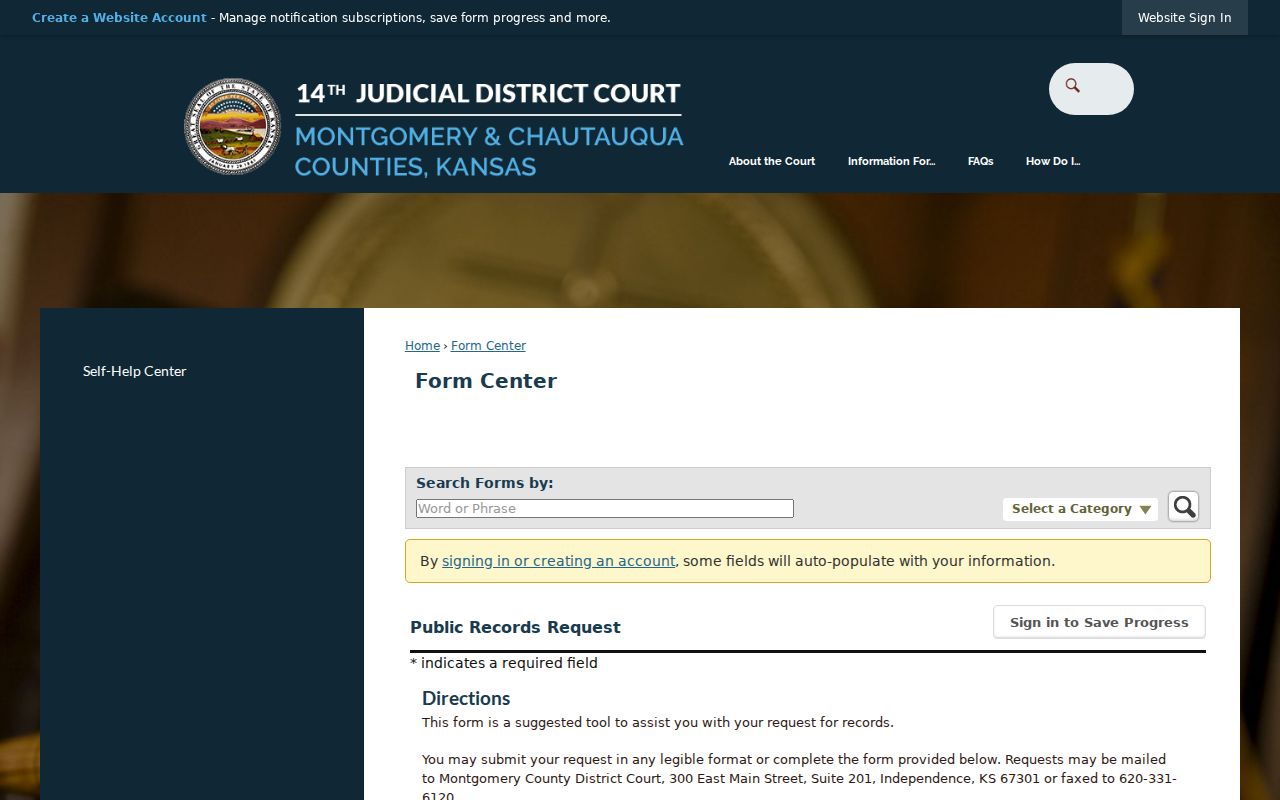
The official form shows the contact details, a description field, print and submit steps, and the anti-bot checks a written request must pass.
Court Record Types
A docket is an index, not the whole file. Its events index lists filings and actions by date. A posted hearing docket is just a session list. The filed papers themselves include pleadings, notices, motions, orders, journal entries, and judgments. A transcript records what was said at a hearing and follows a separate request path. A certified copy is simply a clerk-authenticated copy of a named record.
- Case information and chronological events indexes
- Complaints, petitions, answers, motions, and notices
- Orders, journal entries, judgments, and dispositions
- Public civil, criminal, probate, limited-action, small-claims, and traffic files
- Hearing transcripts requested through the local transcript form
The Fourteenth Judicial District local-links page separates court, county, and city resources.
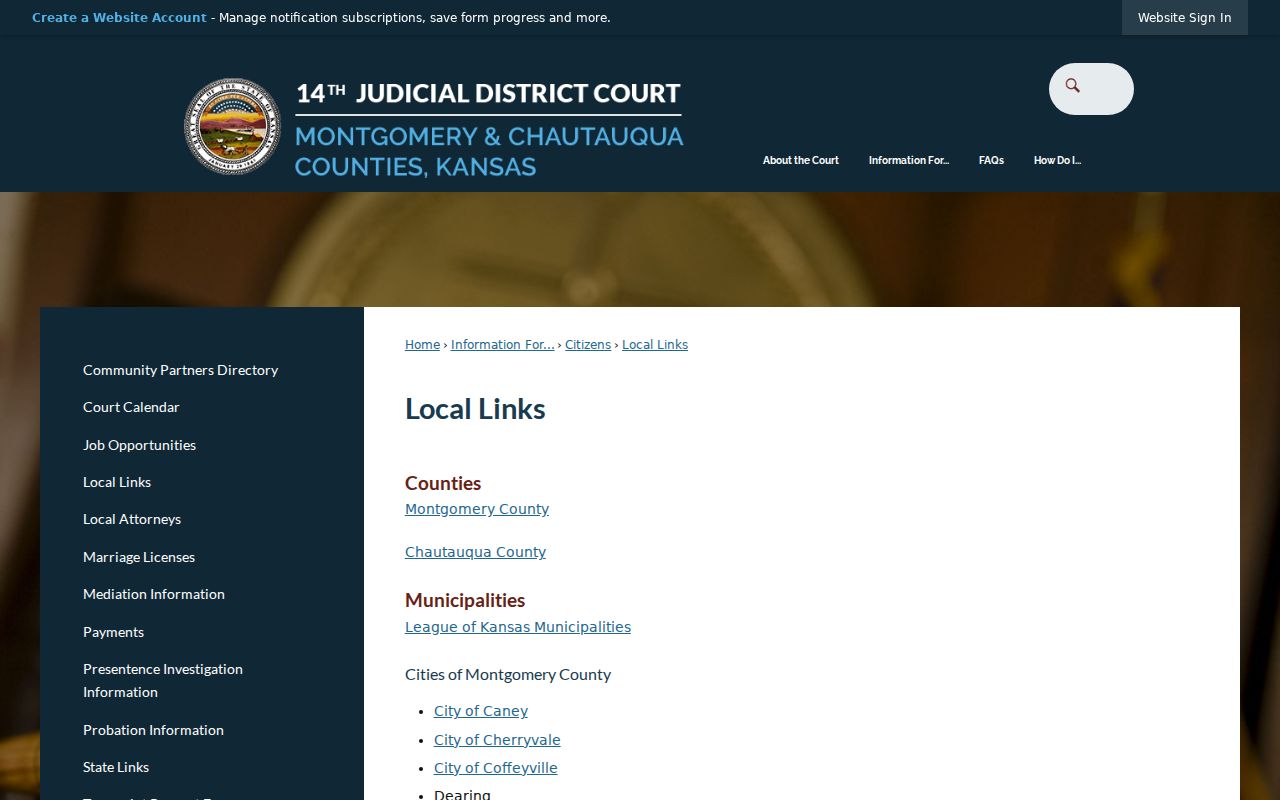
That distinction matters when you request a district record. The Montgomery County Clerk is not the district court docket clerk, so send district requests elsewhere.
Montgomery County Court Record Terminals
A courthouse terminal is a core Montgomery County court record channel. The local FAQ confirms that an open file can be viewed on a public-access computer. That computer sits at a District Clerk's Office. A terminal may show public material that remote CaseSearch does not. Restricted cases and sealed documents stay off limits. Go to the Independence office at 300 East Main Street, second floor. Or use the Coffeyville office at 102 West 7th Street, third floor. Both clerk counters are open weekdays. Hours run 8 a.m. to noon and 1 p.m. to 4 p.m. Bring the case number and the record's name. Independence takes calls at 620-330-1070; Coffeyville at 620-251-1060. Phones work for routing, not for filing the required written search request.
Inside a Montgomery County Court Record
The file ties each short docket entry to the papers behind it. A posted hearing sheet may show less than the full case record. Read every field for exactly what it says. "Review," "Plea," or "Sentencing" names a setting. It does not prove the event occurred or establish the outcome.
| Case Number | Location, year, type, and sequence identifier, often with MGI or MGC. |
|---|---|
| Parties and Counsel | Public names, roles, attorneys, and pro-se status when rules permit. |
| Events Index | Dated filings, notices, hearings, continuances, orders, and disposition entries. |
| Filed Documents | Public pleadings, motions, journal entries, judgments, and available images. |
| Settings | Judge, date, time, type, court location, and connection note. |
Kansas eCourt rules call the chronological index an events index or register of actions. Neither term means the entire case file. A document image, official certified copy, and transcript are separate products.
Montgomery County Court Record Transcripts
A transcript is not a docket copy. The official transcript request form requires the case number, hearing date, and requester phone number. Fields are also provided for the judge, hearing type, names, email, and address. The form lists no transcript rate or processing time. So get a current quote before ordering.
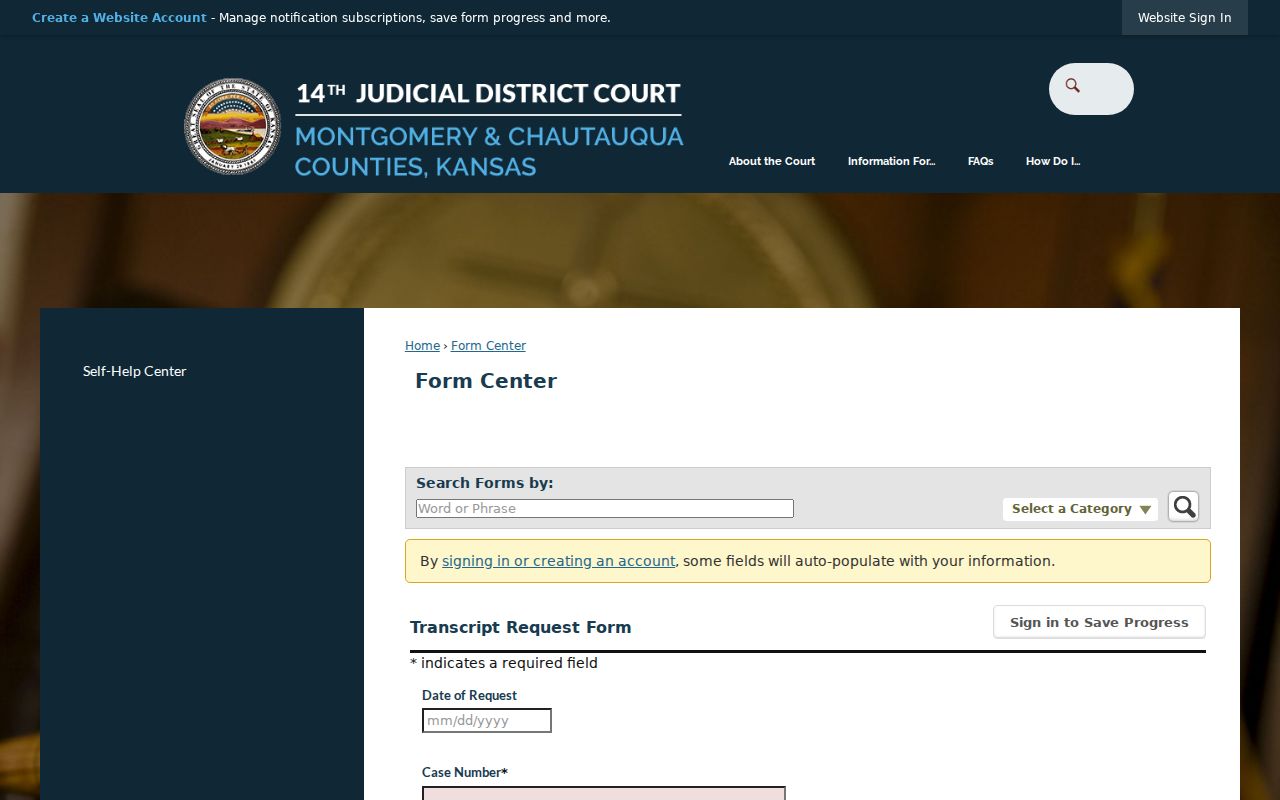
The hearing date matters. A transcript request targets one proceeding, not the whole Montgomery County events index.
Fees and Certified Copies
A plain copy reproduces the record. Certification adds the clerk's authentication to a named document. Basic CaseSearch displays no user fee, but that waives nothing; copy, certification, research, retrieval, and fax charges may still apply. Confirm the total before you pay.
| Item | Current local amount |
|---|---|
| Plain copy | 25 cents per page |
| Certification | $1 per document |
| Act of Congress attestation | $5 each |
| Extended research | $13.50 per hour |
| Off-site retrieval | $30 first file; $15 each additional file on the order |
| Fax | $1 per page |
Montgomery County District Court Clerk
300 East Main Street, Suite 201
Independence, KS 67301
620-330-1070
Montgomery County Judges and Records
The judge named on a docket is case metadata. Record fulfillment stays with the District Court Clerk. The current Fourteenth Judicial District roster identifies district and magistrate judges serving Montgomery and Chautauqua Counties.
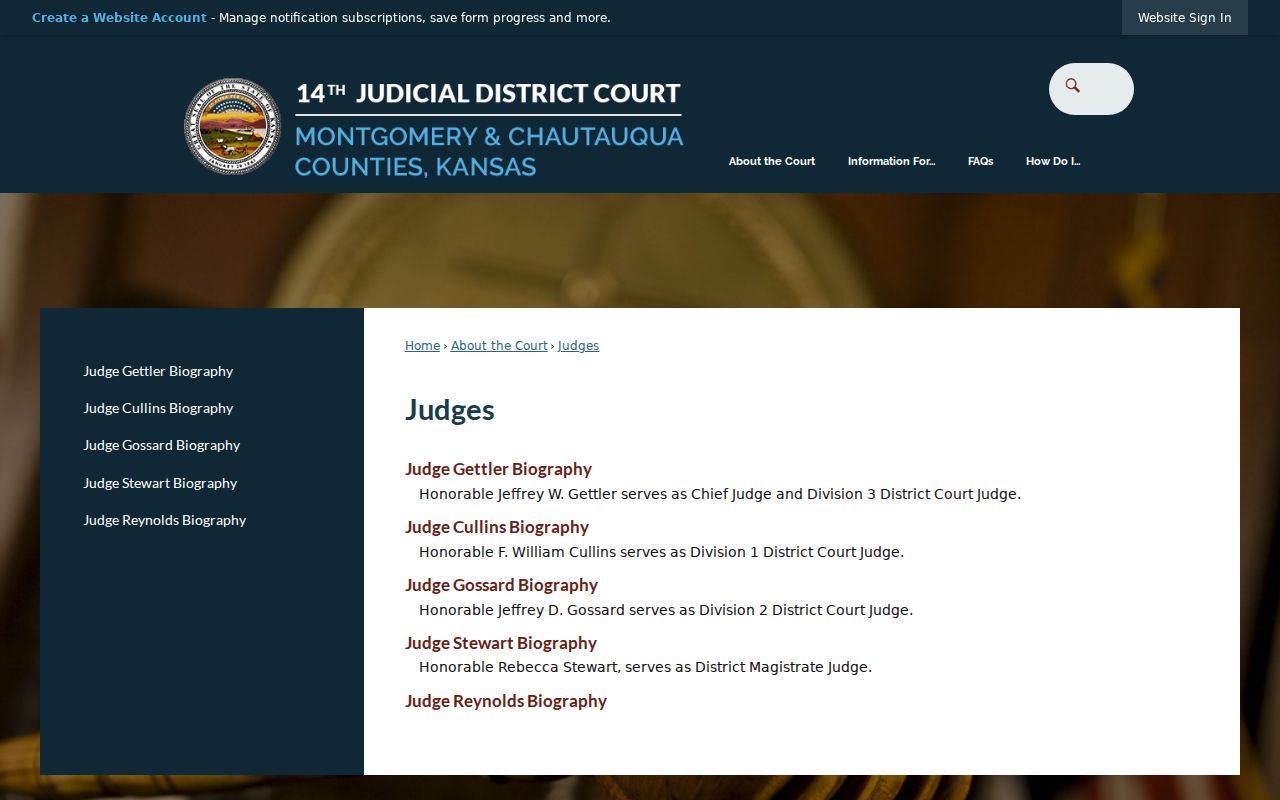
The roster separates the judge assigned to a Montgomery County case from the clerk who keeps the court record.
For background, the Judge Cullins biography covers Montgomery, Caney, and Coffeyville straight from the court's own page.
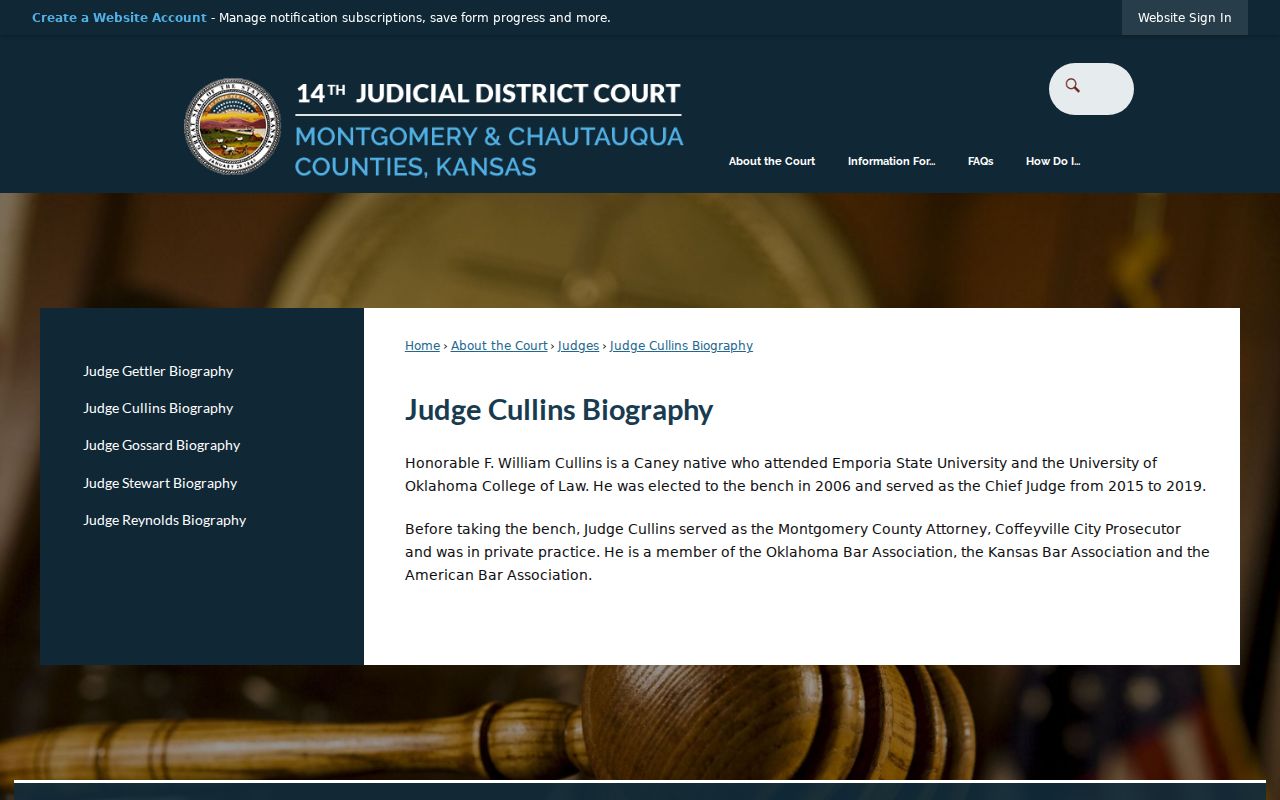
A biography can explain a name on an older docket setting. It never replaces the current register.
The Judge Gossard biography adds Coffeyville context from an official court source.
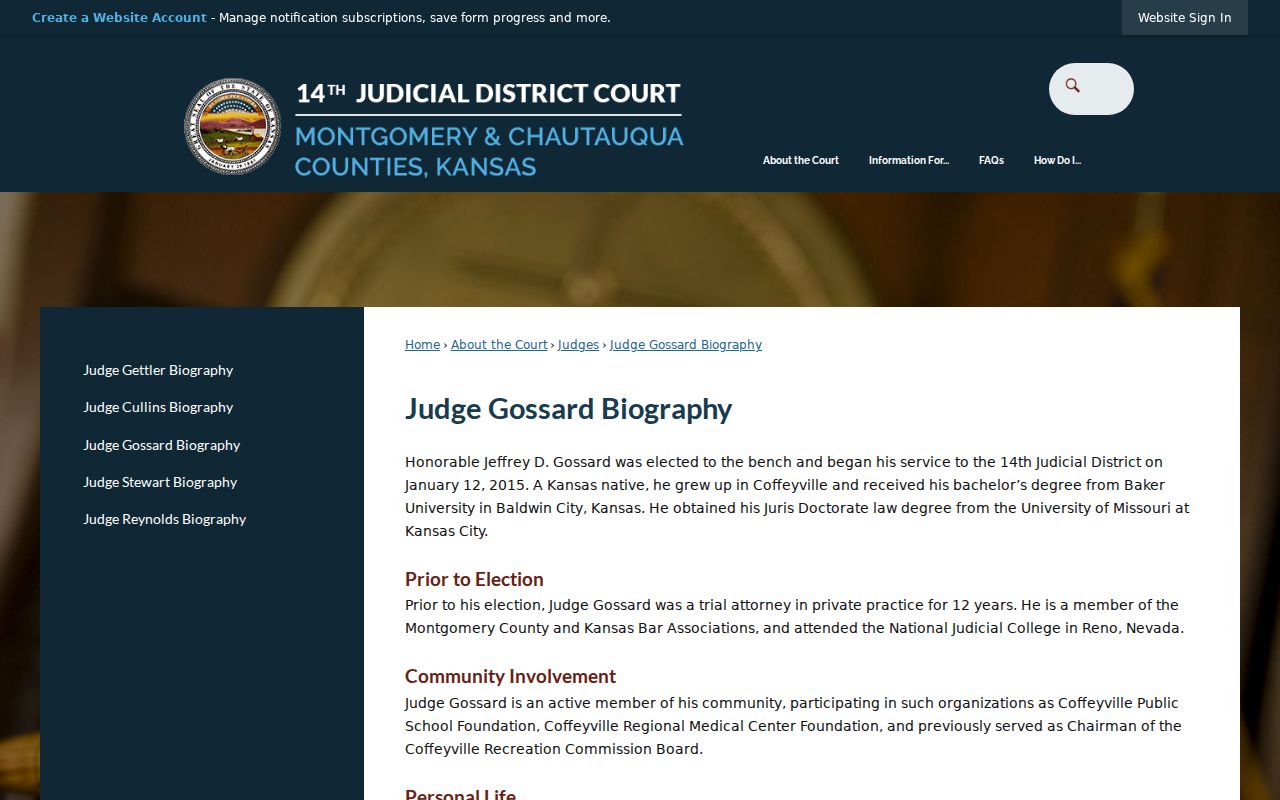
Treat a judge's background as context for reading the roster, never as a stand-in for a filed order.
Sealed Records and Public Access
Kansas law opens most records to the public. The Kansas Open Records Act supports access to nonexempt files, while Kansas Supreme Court Rules 22 through 24 govern electronic access, sealing, and redaction. Adoption, juvenile, child-in-need-of-care, expunged, and protected family cases, among other listed types, may be closed to view. Even when a case is open, presentence reports and unexecuted warrants can stay restricted.
Key rules:
K.S.A. 45-218 addresses inspection, response timing, fees, and explanations for delay or denial.
Kansas Supreme Court Rule 22 defines electronic access and inaccessible case or document categories.
Kansas Supreme Court Rule 24 assigns redaction duties for protected personal information.
Nothing came back on your docket search. That blank result is not proof no record exists. The file may be sealed, expunged, restricted, outside the portal's image range, or filed in another court. The clerk can explain procedure. But no clerk can override a seal or give legal advice.
Accessible, restricted, and sealed are three different outcomes. An accessible case may still hold a document that Rule 22 bars from public electronic access. A restricted case type does not open just because its general category appears on a calendar. Unsealing a file takes the process set by law and a court order. A public request alone never does it. Rule 24 also protects full birth dates. It covers account numbers, protected residential addresses, and names in specified protected roles.
Historical Montgomery County Court Records
CaseSearch is the wrong tool for some old files. The Kansas Historical Society keeps a Montgomery County inventory of older records. It covers district civil and criminal files, city-court appearance dockets, naturalization materials, and probate or guardianship records. Some sit in bound volumes. Others live on microfilm. Go to the modern clerk only if the file you want remains in court custody; otherwise use the archive inventory to identify the collection and its format.
That split also explains off-site retrieval charges. A public file is not always at the counter. Staff may have to pull it. Before ordering copies, ask whether the file is held locally, off site, or by the state archive. A historical docket suits genealogy or local-history work well. Still, do not confuse it with a current certified court record.
Dates matter here. The local court reports that ordinary paper files stopped being kept after January 1, 2018. Statewide rollout material places the Fourteenth Judicial District's centralized Kansas eCourt conversion in November 2020. Those facts describe different steps. The move to electronic records came in stages. Neither one proves that every older image is online, so start with CaseSearch. Then ask the clerk or the archive which office and format cover the year at issue.